
Game Similarity Engine
Introducing Our AI-Powered Similarity Engine.

What It Is: Your New Betting Research Assistant
At Baseline.ai, our primary weapon has always been the Multi-Layer Betting Engine.
You know the stack: We start with the Shared Tempo Model to set the baseline. We run that through Decision Trees to reach a consensus. Finally, we optimize everything through our AI Nodes: filtering for alpha, applying system strictures, and outputting a final, calculated prediction.
That engine is the “calculator.” It tells you what should happen based on raw predictive power.
But today, we are introducing the “validator.”
Meet the Game Similarity Engine: a new tool designed to work alongside our core predictions to give you the one thing a model alone cannot. Historical Precedent.
Why It Helps:Validating the Model
Why did we build this if we already have a powerful prediction engine? Because context is king.
When our Core AI Nodes flag a strong over, you trust the math. But the Similarity Engine allows you to see the math in action.
Confirm the Core: If our main engine predicts an Over, and the Similarity Engine shows that the 5 most statistically similar games in history also went Over, your confidence level should skyrocket.
Spot the Traps: If our model shows an edge, but the historical comps show a “Rock Fight” (low scoring grinder), it forces you to pause and re-evaluate the variance.
Validate Your Gut: Have a feeling a game will play out a certain way? Use the engine to confirm if similar matchups in the past actually did.
Inside the AI’s Brain: How It Works (Visualized)
We don’t want this to be a black box. Here is a look under the hood at how the engine actually thinks.
Visualization 1: The “Universe Map”
Think of every college basketball game as a star in a giant universe. The engine uses a technique called Principal Component Analysis (PCA) to map the location of every single game based on its statistical features.
As you can see in the image below, it places today’s game (the blue star) on the map and then draws a tight circle around it to find its nearest neighbors: its Historical Comps (the green dots). Everything else is just noise.
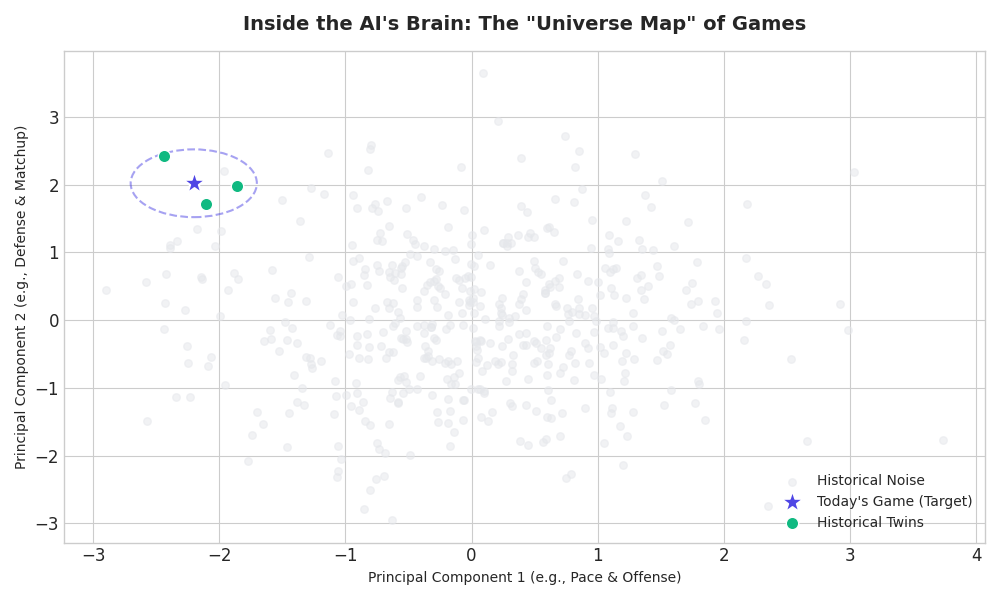
The AI identifies the historical comps that are statistically closest to today's target game.
Visualization 2: What Matters Most?
Not all stats are created equal. The engine uses a weighted algorithm to determine similarity. For example, a difference in tempo might be far more important than a small difference in a team’s recent win percentage. The chart below shows a simplified breakdown of how the engine weighs different factors to find the best matches.
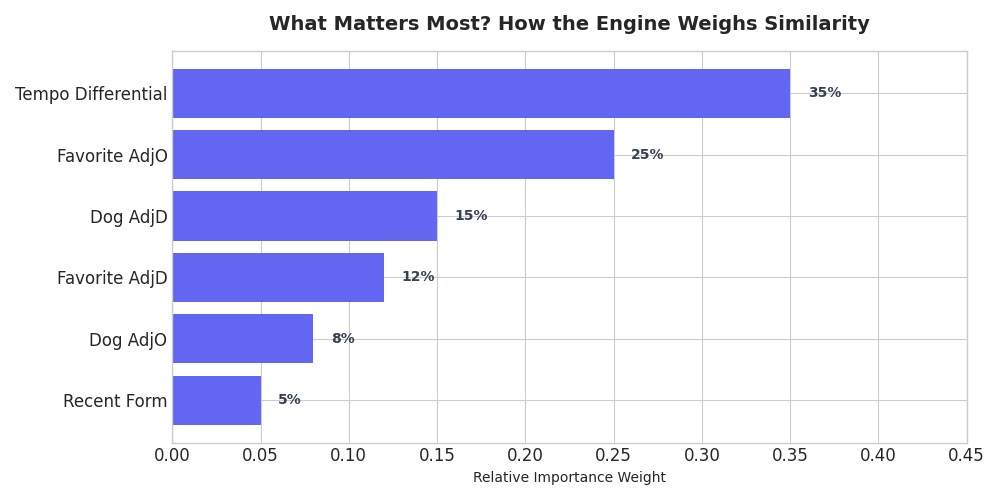
A look at the relative importance of statistical features our engine uses to calculate similarity.
How to Use It: A Simple Workflow
The Similarity Engine is designed to fit perfectly into your daily routine alongside our primary model guidance. It’s updated to show the daily slate hours before tip-off.
Check the Core: Look at the Baseline.ai daily board. What is the Consensus? What are the AI Nodes predicting?
Run the Similarity Engine: Click the button to perform the historical search on that specific matchup.
Analyze the Comps: You’ll get a list of the top 5-6 most similar historical games.
Synthesize: Look at the average outcomes of those comparable games. Do they align with our guidance? If the Guidance and the Historical Comps both point in the same direction, you have found a massive edge.
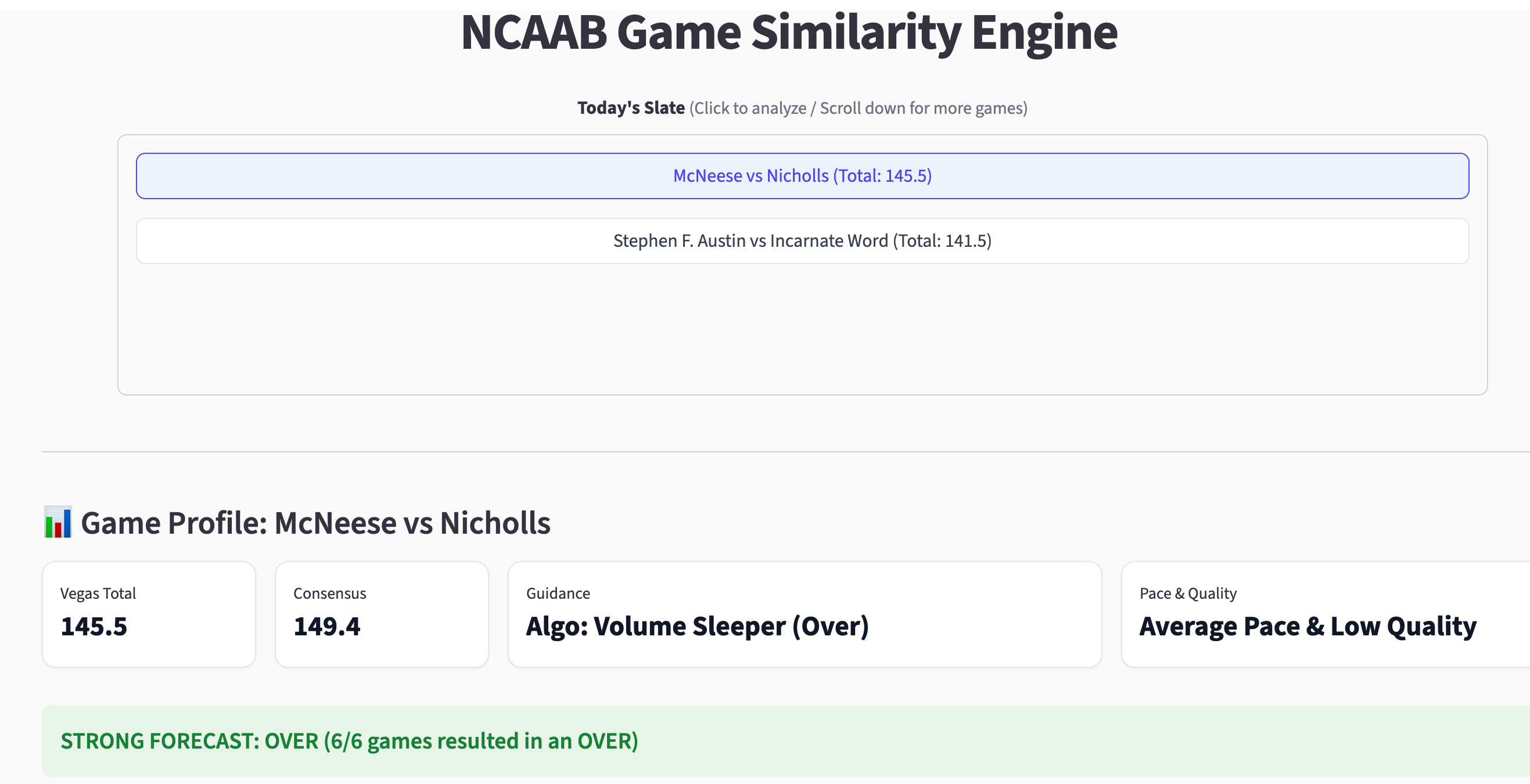
Visualization 3: The Engine in Action
Here is a perfect example. Let’s say our core engine predicts a total of 152.5, but Vegas has the line at 142.5.
You run the Similarity Engine and find that the 6 most historically similar games had an average total of 153.2.
Now you have the Predictive Model (our core multi-layered betting engine) and the Historical Precedent (the new similarity engine) both screaming that the line is too low. That is how you bet with conviction.
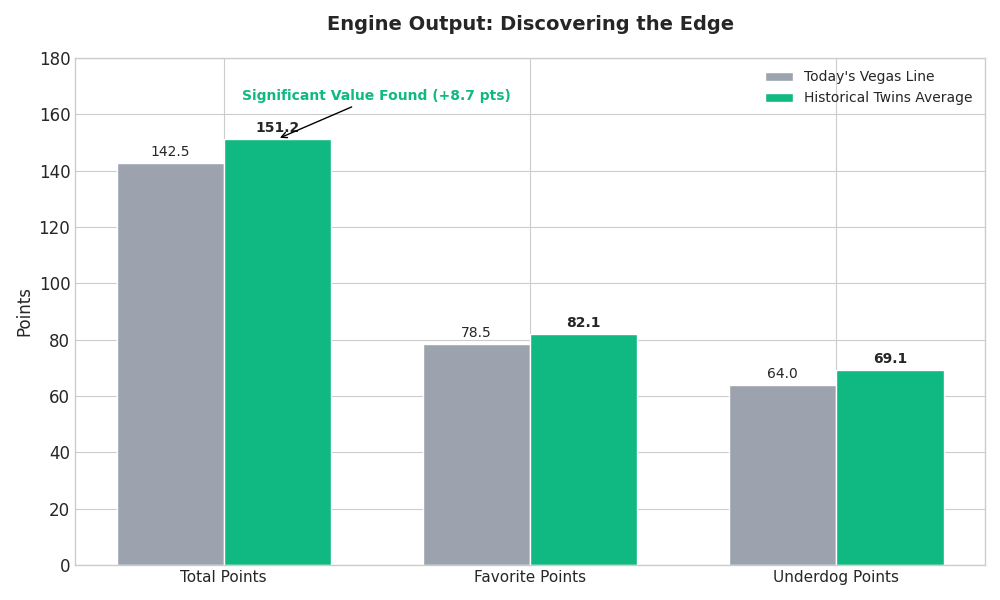
A real-world example where the historical comps suggest the game will be much higher-scoring than the current Vegas line implies.
Why You Need This Tool (aka The Sales Pitch)
In the world of sports betting, information is power, but confluence is profit.
Our new Game Similarity Engine provides an objective, data-driven second opinion on every game on the board. It uncovers edges that are invisible to the naked eye and serves as the ultimate sanity check for our primary betting engine.